Remembering Mom

I attended a play at the Rosebud Theatre some time ago. It was a comedy about death. The dead person was a mother and two of us sitting in the audience had just lost our mothers to that very real and ever-present scourge, cancer. You wouldn’t think we’d find anything about that play funny, but we did. We laughed uproariously as the “Last Supper Committee” prepared the lunch in the kitchen and the harried funeral director tried to manipulate everything so that there would be at least a few people attending the “viewing.” You see the mother in this play wasn’t someone you would remember fondly. But I laughed and I cried and I thought of my mom.

Mom’s life wasn’t always easy. She was an only child of a single mother, raised in a small town during the 20’s and 30’s. She started to work in a florist’s shop when she was only twelve, met my father when she was sixteen, married him when she was seventeen but didn’t tell anyone for a year due to “complications” in both families. They had two children and then she said good-bye to her husband for almost six years as the Second World War raged. She welcomed a stranger home at the end of that time, had two more children and followed him five hundred miles to a new community and a new risk as they opened their first family shoe store. They opened a second store just as a large department store opened across the street. They lost their businesses, their home, more than a few friends. My mom’s mother came to live with us all and more challenges came with her. My father developed bleeding ulcers and almost died. More than once.

Through it all, Mom clung to her faith in God and tried to put a positive spin on even the most difficult of circumstances. When she was eighty years old someone gave her a new purse. When I admired it she said, “Yes, it’s nice but it’s kind of an old lady’s purse, don’t you think?” When I reminded her of her age she looked surprised, then laughed at herself. “But I’m not that old, really,” she said. It was many more years before she finally did seem “that old.”

My mother would have liked the play we saw in Rosebud. She had a strong sense of irony and a deep vein of humour that often rose to the surface for all to see. She would have liked the honesty of it – the way the characters finally admit their true feelings, their fears and their flaws. She would have liked the healing of it too – the healing that happened in the play and the healing that happened in the audience. Because Mom knew you couldn’t take life or death too seriously. She knew there was something more for us all. Now she’s enjoying that “something more” firsthand. I miss her. But I smile when I think of her. And that’s a gift for which I am very grateful.

****

To hear about my comings and goings and my writing/speaking ministry, subscribe to my newsletter Words to Take Us Home

An Easter Perspective on a Good Friday

Mark 15:16-20

Photo by Wim van ‘t Einde on Unsplash

I moved slowly along the path laid out through the sanctuary, lit by tiny candles. Soft, rather mournful music set the tone. The stations of the cross were positioned along that path, each containing a passage of scripture and a piece of artwork. We had been encouraged to take our time, to let the visual depictions move our minds, our hearts and our souls as we focused on Jesus.

The very first image almost undid me. It was an impressionistic sketch of Jesus in the garden of Gethsemane. Our Saviour, bowed to the ground, mourning. Each successive depiction was powerful in its own right but, it wasn’t until I came to one of the largest displays that I caught my breath.

A high bower held a stylized crown of thorns, its spears facing out toward me, seeming to stab the air. You had to look through them to read the scripture, (Mark 15:16-20, ESV): “And the soldiers led him away inside the palace (that is, the governor’s headquarters) and they called together the whole battalion. And they clothed him in a purple cloak, and twisting together a crown of thorns, they put it on him. And they began to salute him, “Hail, King of the Jews!””

There was something powerful about that perspective, looking through that crown of thorns. The immensity of His humiliation left me stunned, my heart hurt by it, my mind trying to fathom it and my soul crying out because of it. The creator of the universe, enduring, indeed, allowing, such degradation, on my behalf. On your behalf.

I have seen many Easters over the 42 years since I became a believer. Many of them, to my shame, slipped by with barely any stirring in my heart, mind or soul. I pray it may not be so over the next span of however many years God allows me to sojourn on this earth. I pray I will always remember this perspective, peering through the crown of thorns, letting the words of scripture stab my soul. I pray I will never fail to take time to ponder the Via Dolorosa, the way of sorrow He endured willingly, in order to open the door to reconciliation with His Father.

I pray my face will always be wet with the tears I wept that day, in awe and thankfulness for so mighty, so merciful a Saviour.

In Good Company

Photo by K. Mitch Hodge on Unsplash

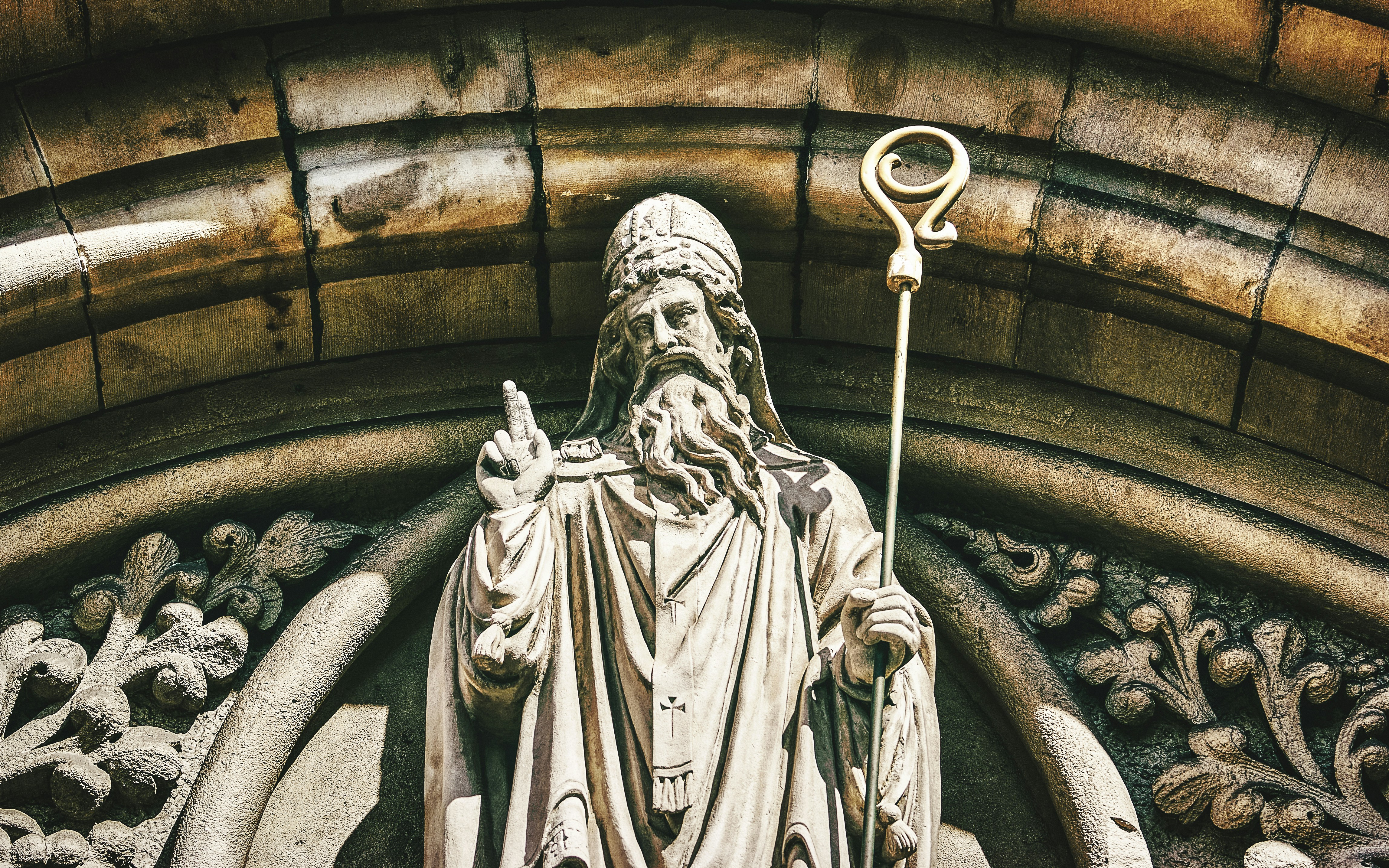
With Saint Patrick, We Stand in Good Company

Both young men must have thought their lives were over. Taken into a country of foreigners where they were sold into slavery, they must have despaired of ever seeing their families and homelands again. They had to adapt to a new culture, learn a new language and suffer the humiliations of slavery. They must have believed God had abandoned them. But God does not abandon his people. These two young men, one who lived hundreds of years before Christ, the other hundreds of years after, would change the course of history. God gave their lives a purpose and meaning that could only have come through the struggles they endured.

Joseph, son of Jacob, father of the Hebrew nation, was responsible for saving not only the people of Egypt from starvation, but his own family, and therefore the Hebrew nation as well. And Patricius, a sixteen-year-old Briton who would become known as Patrick of Ireland, was the first to take the message of Christ to that nation, the very country where he had been enslaved.

 There is another man whose life took a turn for the worse. He was in the prime of his life. He had a huge following among common people and those of influence. It looked like he was going to take the nation by storm. But then he took his friends aside one day and told them he was going to die, and very soon. He told them be would suffer indignities and be treated like a criminal. He told them it would look like utter defeat. But God does not abandon His people. That young man’s name was Jesus.

As with the stories of Joseph and Patrick, God had a purpose for the suffering Jesus endured. It was a purpose that would change the history, not just of a nation, but of mankind. The suffering and death of Christ freed us all from slavery, slavery that was meant to separated us forever from our Father. But God’s purpose could not be thwarted. Through the death of Jesus, His will was accomplished. We were reunited with our true family, reinstated in our true country. What looked like defeat was in reality complete victory.

There are times in all our lives when it appears God has abandoned us. We see the horrors of wars and famines raging all over our world. We experience the loss of loved ones to the plagues of cancer and other diseases that seem to be out of control. We cry out at the injustices that happen every day.

But God has not abandoned us. He will bring all things to completion in His time and according to His purposes. Therefore we can stand in good company, with Joseph, Patrick and Jesus, and repeat the words of Paul, “Yet I am not ashamed, because I know whom I have believed and am convinced that he is able to guard what I have entrusted to him, for that day” (2Timothy 1:12).

Mourning Turned to Joy*

Photo by Mihail Tregubov on Unsplash

John burst through the door of the cabin. His voice rising to a high pitch, he yelled as all eyes turned toward him. “Gord, your house is on fire!” Everyone leaped up and headed for their vehicles. It was almost midnight but the sky was lit by an eerie glow. Gord and Wendy had built their two-story log home only a few months before. It was their dream house, but the building wasn’t what they were thinking about as they sped toward the blaze.

They had left their twelve year old daughter at home, babysitting her three younger sisters. As they pulled into their driveway it was obvious they could go no further. The heat from the flames shooting high into the air, was too intense. They held each other and watched their home burn to the ground, hoping against hope that their children had gotten out. It was a full hour before they knew the fate of their four girls. Wendy later said it was the longest hour in her life.

Their eldest girl, Leslie, had woken to a strange sound. As she came wide awake, she realized it was coming from the chimney of their wood stove. By the time Leslie ran downstairs, the roof was on fire. She woke her sisters, grabbed their winter boots and coats and got them out the door. In -50 degree temperatures, she knew they had to find shelter, so she led the girls to a neighbour’s cabin. When Wendy and Gord were reunited with their children, all the possessions they had lost in the fire were irrelevant. Relief and joy spilled out in thankful tears.

Their girls were alive! Nothing else mattered.

Some 2000 years ago, a group of men and women gathered in a closed room, hiding. Suddenly some women burst into the room, yelling. “He’s gone, His body is not there. He is risen!” Unlike Gord and Wendy, the men and women in that room knew their loved one was dead. They had watched his agony and been there the moment he called out, “It is finished.” No wonder they did not believe what the women told them. Imagine their relief and joy when Jesus suddenly stood among them, dispelling their doubts, telling them not to be afraid. Imagine the tears of thankfulness as they realized that what he had foretold had come true. Though he had been crucified, he had been resurrected. As the truth dawned on the followers of Christ, all the confusion and sorrow was swept away.

Jesus was alive. Nothing else mattered.

Nothing else matters. Jesus is alive, “and repentance and forgiveness of sins will be preached in His name to all nations” (Luke 24:47). “Consequently, he is able to save to the uttermost those who draw near to God, through Him, since he always makes intercession for them. “

That is the joy of the resurrection, the joy that lives in the heart of every person who believes. It filled the hearts of those men and women 2,000 years ago and it will fill your heart today. Say yes to Jesus and experience the joy.

  • Excerpt from Marcia’s devotional book, Spur of the Moment, available from the author or on Amazon.

Daffodils and the Longings of Our Hearts

I purchased a bunch of yellow flowers yesterday. Those who decide where to put what in grocery stores must have lived in Canada during the winter. The profusion of daffodils placed at the entrance of the store were not only eye-catching, they filled me with longing for spring and a need to relieve that longing. I had a bunch in my cart before I even thought about the price or the marketing strategy.

When I woke up this morning, the buds that were just starting to open had bloomed, their bright yellow faces greeting me cheerily. Then I looked outside and groaned at the swirling snow and howling wind. These daffodils obviously did not come from any garden in Alberta. As I admired them, I thought of a friend of mine. She told me they were her favourite flowers because they are among the first to pop up when spring has arrived. She knows about longing for spring too. She too has lived in cold and desolate places where people are sustained by the warmth of friendships and dreams of sunshine. She too knows about longing for colour and fragrant winds and the smell of the earth. Daffodils are a sign that we will not always have to wait, that the longing will be satisfied with good things. They are a sign of hope, telling us to hang on, spring is coming. When blizzards are blowing, we desperately need that hope.

When the storms of life are blowing we are in desperate need of another kind of hope. When the ordinary cares of daily life swirl around us, we need to know that the goodness of God is enough. We need to believe He will satisfy the deepest longings of our hearts. The longing for spring, for beauty and for good things are only shadows of that deeper need, the need for spiritual satisfaction. In Psalm 63, David says – “My soul thirsts for you, my body longs for you, in a dry and weary land where there is no water” (v.1). Then he declares – “My soul will be satisfied as with the richest of foods; with singing lips my mouth will praise you” (v.5). 

Nothing can satisfy that deep longing but God Himself. We can try to fill it will all kinds of “good” things, but that will only take the edge off, only satisfy temporarily. In the end, the longing increases. The daffodils on my kitchen table won’t really satisfy my longing for spring. As they die, they will only serve to increase it. The writer of Proverbs says – “Hope deferred makes the heart sick, but a longing fulfilled is a tree of life” (Proverbs 13:12). The longing will continue until our focus is turned to the One who can completely relieve it.

Jesus promises to satisfy that longing. He longs to meet us, to draw us into a relationship that will ease the ache of being apart from Him. Let Jesus satisfy the longing in your heart. Meet with Him today.

Excited About this

Coming Soon!

The Day I Faced My Failure

Photo by Johnson Chou on Unsplash

This time of year makes me a bit jittery. It’s that time when people ask, “Do you garden?” I take that question personally. I guess it’s a hold-over from my Yukon days, but I always have the feeling the person is really asking, “What are you good for, anyway?” The question always makes me squirm because I’m not good at it. I inherited my mother’s black thumb. I’m death to fruits and vegetables.

Not that I haven’t tried. For twelve Yukon summers I dutifully planted rows of cabbage and broccoli, peas and lettuce. I even built a greenhouse and kept a fire burning in it at night to keep a few tomato plants alive. Once I replanted three times when late frost hit, only to have it all wilt  from an early one in August. With a season of twenty-four hour sunlight, the plants that survived grew furiously. So did the weeds. A neighbour once drove by, honked and called out – “tendin’ the weed bed, are ye?”

I wanted to give up, but at the end of each summer, I harvested what had managed to survive. I was thankful there was a grocery store in town. We surely would have starved if we’d had to live on what I could grow.

When we moved to Alberta, I anticipated the “game” would go on, but was delighted that there were so many grocery stores to choose from. When spring arrived, I dutifully got out my spade and tested the ground in the back yard. But, oh, woe is me, it was full of roots! The large old cottonwood in the corner of the yard had spread its thick underground fibers far and wide. My husband took a turn at the spade but could find not a single spot suitable to till. Such a pity.  

Having an excuse eased the guilt, but I feared my failure was apparent to the world. When friends asked if I wanted their harvested leftovers I always said yes, with thanks, but had that nagging suspicion they were pitying me. I knew I was a failure. So did they.

Then one day, a friend asked if I’d like some potatoes. Seems she’d planted way too many and they all grew wonderfully (of course!). My family and I spent a morning digging up her potato patch. It was one of those special times – a glorious morning with the smell of earth freshened by rain and the delight of children’s voices in the crisp air. But the most wonderful part was the look on my friend’s face as we loaded the boxes of food into our vehicle.

“I just love being able to do this,” she said. “Thanks for coming out.”

The power of her words hung in the air around me for days as a simple truth sank in. There were things I loved doing that could be a blessing to others. I don’t have to be good at everything. It’s okay to be a failure at gardening. It’s not my gift.

1Peter 4:10 says – “Each one should use whatever gift he has received to serve others, faithfully administering God’s grace in its various forms.” My friend did a great job of that the day she invited us to her potato patch. On that day I started admiring the work of people with green thumbs, without feeling guilty. They have that gift. I have others.

Do you know yours?


Other places to read my work:

On Medium.com find me at https://medium.com/pondrings and https://medium.com/koinonia and a few other publications along the way.

And on InScribe Writers Online

And be sure to sign up for my newsletter, Home Words, to receive CASSIE, a FREE SHORT STORY in exchange for sporadic updates.  😊

Home: Is It Where Your Heart Is?

A while ago our neighbourhood was turned into a beautiful winter wonderland. The temperature had dropped suddenly and for a while we were shrouded in thick fog. When that cleared, the sun came out and everything sparkled as though it had been painted with a fairy’s brush. The thick frost was dazzling. As I walked Livy that day I remember thinking,

What could be more beautiful?

I love where we live. It’s a quiet neighbourhood full of large trees, crisscrossed with walking paths dotted with boxes of doggie bags at strategic places. On a calm night we can hear the gurgling of the river behind us and the lights from the small town aren’t enough to block out the stars. Deer often wander up from the nearby woods and now and then a moose will jog down the street. I often fall asleep to the sound of coyotes yipping at the moon. Yes, I love it here.

But it’s not where my heart belongs.

My heart belongs in a faraway place that I’ve never seen, a place that, unlike our current home, can never be corrupted or destroyed. Matthew 6:19 & 20 says – “do not lay up for yourselves treasured on earth, where moth and rust destroy and where thieves break in and steal, but lay up for yourselves treasures in heaven, where neither moth nor rust destroys and where thieves do not break in and steal.” (ESV)

I thank the Lord every day for giving us such a beautiful place to live, but my true home is where my Saviour is, where my Heavenly Father lives. Remembering that truth keeps me from grasping for the eathly things that will fade away, rather than focusing on those things which are eternal.

Home. Is it where your heart is?

****

I Want To Be Like Babe

Photo by Danny Gallegos on Unsplash

The wrangler patted my horse’s neck. “This is Babe,” he said, “and she’s been trained as a cutting horse. Know what that means?”

I nodded. I’d seen cutting horses in action as they stepped into a herd of cattle, singled out a steer and manoeuvred it until it stood alone or was forced into a nearby shute. I knew cutting horses were trained to respond immediately to the rider’s cues.

Babe was definitely a cutting horse. The slightest touch of the rein on her neck made her respond, indeed, leap to respond. She almost put me off a couple of times, as we made our way along the mountain trails, but once I got used to her she was a delight to ride.

I thought of Babe one time, when I felt a nudge from the Lord. But I was busy that day so I ignored it. The next day I felt the push again, but again, I dismissed it. I’ll make the call later, I thought. But the days flew by. The nudge kept coming, so finally, more than a week after I felt that first prompting, I picked up the phone and called my friend. “Been thinking about you,” I said. “How’s life?”

There was silence for a moment, then a soft whimper. I heard my friend take a deep steadying breath. “My mom died a week ago.”

I groaned and expressed my sorrow. We chatted for some time and then said good-bye. “Thanks so much for calling,” my friend said. “It means a lot.”

I was so glad I’d finally responded to God’s prompting. But I couldn’t help but wonder if my words would have been more of a help if I’d called right away, on first nudge.

Lord, I prayed, make me like Babe. Make me willing to respond to your voice immediately. Make me as eager to obey as Babe was.

I want to be like David, too, as he says in Psalm 119:59,60 – “When I think on my ways, I turn my feet to your testimonies; I hasten and do not delay to keep your commands.”

****

Sign up to receive my newsletter, Home Words

A Telling Comparison

I squirmed in my seat as I watched the drama unfold on our TV. The scene was disturbing, to say the least. I don’t remember the plot of the movie but I remember that scene.

A well dressed white woman opens the door to her luxurious apartment to find an indigenous woman standing in the hall. There is a long awkward moment before she finally invites her in. She sits on the edge of a dainty chair. The white woman looks down at the woman’s feet, clad in ragged sandals. Her feet are bleeding. The white woman disappears for a moment and returns with a newspaper. The indigenous woman raises her feet without a sound as the white woman places the newspaper under the bloodied sandals.

I could not help but think of that scene when, later in life, I read John 13 for the first time. It’s another scene that perhaps should make us all squirm, as no doubt it did the disciples of Christ that night. Jesus “laid aside his outer garments, and taking a towel, tied it around his waist. Then he poured water into a basin and began to wash the disciples’ feet …” (John 13:4.5, ESV).

The contrast between these two scenes is stark. One reveals a shocking callousness, a hardness of heart, while the other reveals a shocking concern, a compassion that speaks volumes about the one holding the towel.

Imagine the scene that played out in that upper room over 2,000 years ago:

The silence as Jesus, the revered teacher, removed his outer tunic, revealing the short inner one, which in the minds of the disciples meant Jesus stood naked before them.

The gasp they no doubt gave when he tied the towel around his waist, the act of a servant.

The sound of the water being poured into the basin, the disciples no doubt wondering what on earth he intended to do.

Their astonishment would have been complete when he likely got down on his knees before them and washed their feet. No wonder Peter protested. This was a scandalous act, incomprehensible to them, that their master should make himself their servant. It was a demonstration of the love He then commanded from them – a scandalous love that went beyond any convention, beyond their normal experience.

It is telling, too, that the scriptures record that “Jesus, knowing that the Father had given all things into his hands, and that he had come from God and was going back to God, rose from supper …” (John 13:3,4, ESV). It was because Jesus knew who He was that He could, without hesitation, humble Himself before His disciples.

It is only when we understand who we are, children of this same God, and indwelt with His Spirit, that we too are capable of such humility, compassion, and love.

In His Spirit we are able to follow the example of Jesus, rather than the example of a callous woman who showed no sympathy.

The comparison is telling. Which one will you emulate?