John burst through the door of the cabin. His voice rising to a high pitch, he yelled as all eyes turned toward him. “Gord, your house is on fire!” Everyone leaped up and headed for their vehicles. It was almost midnight but the sky was lit by an eerie glow. Gord and Wendy had built their two-story log home only a few months before. It was their dream house, but the building wasn’t what they were thinking about as they sped toward the blaze.
They had left their twelve year old daughter at home, babysitting her three younger sisters. As they pulled into their driveway it was obvious they could go no further. The heat from the flames shooting high into the air, was too intense. They held each other and watched their home burn to the ground, hoping against hope that their children had gotten out. It was a full hour before they knew the fate of their four girls. Wendy later said it was the longest hour in her life.
Their eldest girl, Leslie, had woken to a strange sound. As she came wide awake, she realized it was coming from the chimney of their wood stove. By the time Leslie ran downstairs, the roof was on fire. She woke her sisters, grabbed their winter boots and coats and got them out the door. In -50 degree temperatures, she knew they had to find shelter, so she led the girls to a neighbour’s cabin. When Wendy and Gord were reunited with their children, all the possessions they had lost in the fire were irrelevant. Relief and joy spilled out in thankful tears.
Their girls were alive! Nothing else mattered.
Some 2000 years ago, a group of men and women gathered in a closed room, hiding. Suddenly some women burst into the room, yelling. “He’s gone, His body is not there. He is risen!” Unlike Gord and Wendy, the men and women in that room knew their loved one was dead. They had watched his agony and been there the moment he called out, “It is finished.” No wonder they did not believe what the women told them. Imagine their relief and joy when Jesus suddenly stood among them, dispelling their doubts, telling them not to be afraid. Imagine the tears of thankfulness as they realized that what he had foretold had come true. Though he had been crucified, he had been resurrected. As the truth dawned on the followers of Christ, all the confusion and sorrow was swept away.
Jesus was alive. Nothing else mattered.
Nothing else matters. Jesus is alive, “and repentance and forgiveness of sins will be preached in His name to all nations” (Luke 24:47). “Consequently, he is able to save to the uttermost those who draw near to God, through Him, since he always makes intercession for them. “
That is the joy of the resurrection, the joy that lives in the heart of every person who believes. It filled the hearts of those men and women 2,000 years ago and it will fill your heart today. Say yes to Jesus and experience the joy.
Excerpt from Marcia’s devotional book, Spur of the Moment, available from the author or on Amazon.
I purchased a bunch of yellow flowers yesterday. Those who decide where to put what in grocery stores must have lived in Canada during the winter. The profusion of daffodils placed at the entrance of the store were not only eye-catching, they filled me with longing for spring and a need to relieve that longing. I had a bunch in my cart before I even thought about the price or the marketing strategy.
When I woke up this morning, the buds that were just starting to open had bloomed, their bright yellow faces greeting me cheerily. Then I looked outside and groaned at the swirling snow and howling wind. These daffodils obviously did not come from any garden in Alberta. As I admired them, I thought of a friend of mine. She told me they were her favourite flowers because they are among the first to pop up when spring has arrived. She knows about longing for spring too. She too has lived in cold and desolate places where people are sustained by the warmth of friendships and dreams of sunshine. She too knows about longing for colour and fragrant winds and the smell of the earth. Daffodils are a sign that we will not always have to wait, that the longing will be satisfied with good things. They are a sign of hope, telling us to hang on, spring is coming. When blizzards are blowing, we desperately need that hope.
When the storms of life are blowing we are in desperate need of another kind of hope. When the ordinary cares of daily life swirl around us, we need to know that the goodness of God is enough. We need to believe He will satisfy the deepest longings of our hearts. The longing for spring, for beauty and for good things are only shadows of that deeper need, the need for spiritual satisfaction. In Psalm 63, David says – “My soul thirsts for you, my body longs for you, in a dry and weary land where there is no water” (v.1). Then he declares – “My soul will be satisfied as with the richest of foods; with singing lips my mouth will praise you” (v.5).
Nothing can satisfy that deep longing but God Himself. We can try to fill it will all kinds of “good” things, but that will only take the edge off, only satisfy temporarily. In the end, the longing increases. The daffodils on my kitchen table won’t really satisfy my longing for spring. As they die, they will only serve to increase it. The writer of Proverbs says – “Hope deferred makes the heart sick, but a longing fulfilled is a tree of life” (Proverbs 13:12). The longing will continue until our focus is turned to the One who can completely relieve it.
Jesus promises to satisfy that longing. He longs to meet us, to draw us into a relationship that will ease the ache of being apart from Him. Let Jesus satisfy the longing in your heart. Meet with Him today.
I’m writing to remind you about the Meet & Greet to kick off the Abundant Rain Writing Pilgrimage.
This is a last minute invitation, because the Meet & Greet is this morning, Saturday, February 3rd at 11:00 am MST (Alberta). There’s a Zoom link below if you’re able to come — no need to rsvp.
During the Meet & Greet, Marcia will talk about why she wrote the Abundant Rain devotional journals for writers, and she’ll lead you in a writing exercise.
We will give out some prizes
A small handmade book (crafted by Marcia)
A physical copy of Abundant Rain, volume 1
PDF of Marcia’s Spur of the Moment devotional book
If you miss the live event, we’ll share a replay.
This event will be plenty of fun on its own, but there’s more! It’s also a kick-off and info session about Marcia’s Abundant Rain Writing Pilgrimage that begins next Saturday (10th).
We have put together some discounted bundles for you. For those who register by end of day on Saturday, February 3rd and purchase one of the bundles, we are offering a free writing assessment. www.siretona.com/abundantrain
Hello everyone and thank you so much for hanging in here with me. It has been a while since I posted, I know, but I hope to do so more regularly from now on. I do wish I could slow the days down a bit. How did it get to be the end of January already??
What’s Up Next?
Well ….I’m really excited to join with others once again for the Abundant Rain Writing Pilgrimage, starting with a meet and greet on Feb. 3rd – that’s this Saturday! We’ll have some special bonuses for you that morning (11:00 a.m. MST) and will outline how the pilgrimage will work. We’ll be using a revamped copy of Volume 1 and will get the link to you as soon as we can. In the meantime, there will be a download of the PDF. Do join us, even if you can’t, or don’t want to, do the whole pilgrimage. Here’s the link to get you started
Feel free to share that link with anyone you think may be interested in joining with other writers of faith as we walk this path together.
Update on My New Fantasy Novel:
For those of you following my progress with Pebble, my next fantasy novel, I have been working on it slowly, and hope to have the first draft ready for Beta readers soon. If you would like to be a beta reader – (all that means is, you read the pdf I send and give any feedback you wish) – let me know and I’ll put you on the list. Please pray that I’ll be consistent in the work and that the Lord will lead as I write.
BTW, the other series I’ve been working on has been popping into my head a lot lately too, so stay tuned for more on that as the days go by.
A Bit of Personal News:
Many of you know that we had a tragic thing happen over the holiday season, with the suicide death of a young man who left his wife and three little ones behind. It hit us hard, since it was in the family, though we did not know him well. Please pray for the young mom, that she would find help and support and above all that she would find the Lord.
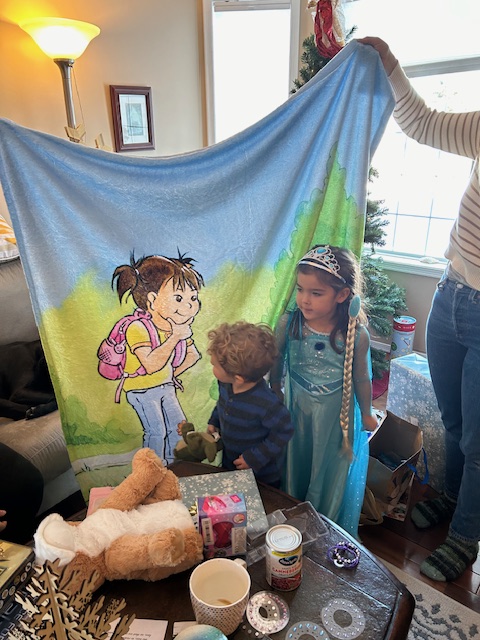
Otherwise, our Christmas was great, with my 3 daughters, their husbands and our 2 grandkids all in attendance. Little Sparky was a delight – I think he loved tearing the paper off all the presents more than the presents themselves. 😉 And Thea was thrilled with the big blanket picturing the front cover of my children’s book, Merrigold’s Very Best Home (a lovely gift from my publisher at Seritona Creative Publishing).
The New Year roared in with very cold temps that kept us inside most of the time, except when we had to venture to Calgary for some medical appointments, mostly for my husband. We were very glad to finally have some tests and prodedures scheduled after many months of things falling through the cracks. It really does help when you have a family doctor who gives consistent care. Spence is scheduled to have a hernia repair done on Feb. 6th. Prayer appreciated for the surgery and for the recovery. 🙂
Livy’s Life
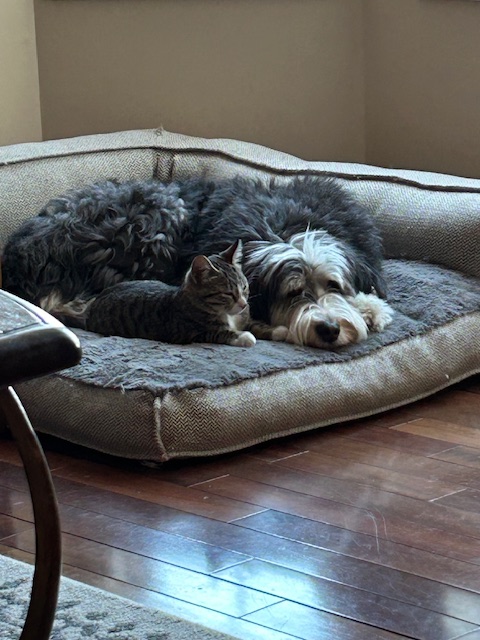
Liv seems to be adjusting to life with her new companion, Little Duffer. I’m not so sure about Spence and I!! 🙂 We keep renaming him – Little Terror, Little Stinker, Mr. Pest, Psycho cat, etc. etc. He is most persistent about joining me as I work on my laptop!
(sorry, for some reason it’s not letting me adjust the size of those 2 pix).
February is shaping up to be quite busy but one of my priorities is keeping in The Word more. I’ve taken on the challenge to read through the Bible in 90 days (thank you, Mary DeMuth!) Tomorrow will be day 30 so I’m 1/3rd of the way through! It truly is wonderful to read large chunks of the scripture and get a more ‘big picture’ view. Our God truly is an awesome God!
Thank you all for your interest and support, once again! I love to hear from my readers, so do pop me a note if you have a minute! Or, if you feel so led, use this link to support my writing. thourgh paypal.
Hello everyone. As many of you know I had some problems with my Mailchimp newsletter. I will now be sending Words to Take Us Home from SubStack. Just click that link to get to the landing page. There is a paid option, if you would like to support my writing/speaking/teaching ministry, but no pressure! Just choose the free option if you prefer.
I hope you will continue to be encouraged and blessed by what God is doing in my life and through my words. As always, you may unsubscribe at any time.
“We and the world, my children, will always be at war. Retreat is impossible. Arm yourselves.” Leif Enger, Peace Like a River
I was born into a world at war. No one told me. No one around me seemed to know.
But it didn’t take long for me to understand that it was so, and I joined in with enthusiasm. At times it seemed as though it was all a game. I was at war with my brother, three years my senior, continually. It was a physical war that left bruises on us both. That made my grandmother cry. That bewildered me and made me feel an unwelcome thing – guilt.
I was at war with my sister too, though it was a much different kind. It was not the knock-down, fist in the gut kind of war with her. She, the first born, warred with steely looks and sighs that said I was merely a nuisance, barely worthy of a mention. But under the fake indifference was a seething anger, because she believed I was the cherished one. She, so much my elder, had to be responsible and take consequences while I “got off scot-free” too many times.
The only sibling I did not seem to be at war with was my other brother, the second born. He waged his war on other fields, a war of constant pressure to raise himself to an unattainable standard. I watched and listened and secretly cheered him on.
I was the brunt of another’s war, often, and to my great frustration. His name was Bruce and he lived two doors down on our street. He was the only son of a brutal man who beat him with a belt. Bruce raged against everything and everyone. I was an easy target, being much smaller, and a girl. My brothers didn’t provide any protection, the one being too weak, the other being too old to notice.
So I was left as a lone sentinel, without a weapon, to try and guard the fortress of my well-being. I was knocked down a lot, but occasionally I won, in a manner of speaking, by discovering that if I could draw attention to the damage Bruce caused me, he’d get a beating far worse than any I could give him. His father became my secret, fearsome ally.
I waged war in forts built of cardboard and rock. I waged war in gardens owned by neighbours and on the school grounds in games of chance and learned skill. I was only about seven or eight years old when I learned that the games could be deadly.
Her name was Stephanie. She was very blonde and very blue-eyed and my mother said that was the problem. “It seems to strike the little blonde, blue-eyed angels,” she said when she told me Stephanie was dying. That day I learned a new word in the vocabulary of the war – leukemia. I remember staring at Stephanie on a swing in the playground the day after I learned that children could die. She was laughing as she pumped higher and higher. I remember hearing rumours of her funeral later and ever since I have turned away from empty swings hanging still in a playground.
Three years later the deadly seriousness of the war struck again. My grandmother disappeared.
I knew she had been waging war for a long time. She argued with my mother daily, in bitter words that made no sense but felt like stones being pelted in my direction. I felt the hatred in her for my father and knew the bile she poured out on my brother came from that same place.
I knew she didn’t like most people, especially the “gypsies,” the dark-eyed children who came to ask if I could play. They weren’t gypsies, but Italians, but to my Grandmother, they were ‘other’ and therefore suspect. I remember a day when a boy I secretly liked came with his little sister and asked if they could use our bathroom. My grandmother’s nose wrinkled and her lips clamped tight and she closed the door without answering. I felt that unwelcome guilt again, and could not look into that boy’s dark eyes at school the next day.
But Grandma made good cookies and let me knead the margarine bag until the red button bled, and made peanut butter toast for breakfast, with tea she sipped first to make sure it wasn’t too hot. When I sneaked into her room late at night, she would get out a large tin box full of buttons and let me sew them together or let me leaf through magazines or watch her small television, until I fell asleep. She must have carried me into my own room each night, because I always woke up there.
And she told me stories, sometimes about the war and the bombs that fell in England, the place where she was born, and the way men are. “Like animals,” she said. “Gorillas. You can’t trust a gorilla.” She told me about working, at the age of eleven, as a maid in a big house near Buckingham Palace, how the liquor bottles were marked so the maids couldn’t drink from them and how they all would rush to the balconies and wave their dusters as the King and Queen rode out in their carriage. She said looking at the Queen’s daughter was like looking in a mirror and she always wondered why she was the maid and the other child a princess.
She disappeared in the fall, on a day that smelled of snow. They found her jacket then, but not her body, until the spring. She had jumped into the tail race that flooded the locks for the huge freighters that passed from Lake Huron into Lake Superior. I remembered she had talked about drowning, said it was a pleasant way to die. When the police came with her jacket, I listened from the stairs high above and knew that a battle had been lost. My father identified her body, but I heard him say it was hard to recognize her. She had been in the water for a long time. My mother didn’t cry until the day of the funeral. I was deemed too young to attend it. I wondered what they had done, what they had said, if they felt guilty about being relieved of her. As I did.
That’s when I armed myself with numbness. I learned a war could be silent, a necessity now that the source of conflict was gone from our home. Don’t do anything to cause it to come back again. Keep the peace at all costs, even if you have to lie. Those were the unwritten rules. I became very good at keeping them. Too good. I spoke little. I made friends only if it was to my benefit.
It was many years later when that curse was broken, and my personal war came to an end. Death had been all around me and at last I sought a way out, a way to know the depth of peace that can only come from one source. I at last acknowledged the shape of the hole in the core of my being that groaned to be filled. It was the shape of a man, a God-man whose name is Jesus.
When He came to me, He lifted my head and opened my eyes and the world became beautiful again, shimmering with an innocence I had thought long gone, long defiled. It beamed from the face of an infant. The world shone with colours I had not noticed, rang with songs I did not know I knew. Though the war still raged around me from every quarter, I now stood protected, armed with truth, able to recognize the lies hissing in my ears, able to rebuff them, able to smile and mean it, able to love with a genuine love that flowed through me but was not of my own instigating. And though the mystery of it all is too deep to understand, when I acknowledge my weakness, I am not beaten down, but comforted, because I believe there is One who fights the battles for me.
And He never loses.
My only sorrow now comes from knowing some I love have not yet recognized their need nor looked into His face and said, “yes.” But even in that sorrow I am not left alone.
Yes, the war rages. But now I am armed.
****
This piece was recently the first place winner in the Personal Essay category in InScribe’s Fall Contest
This time of year makes me a bit jittery. It’s that time when people ask, “Do you garden?” I take that question personally. I guess it’s a hold-over from my Yukon days, but I always have the feeling the person is really asking, “What are you good for, anyway?” The question always makes me squirm because I’m not good at it. I inherited my mother’s black thumb. I’m death to fruits and vegetables.
Not that I haven’t tried. For twelve Yukon summers I dutifully planted rows of cabbage and broccoli, peas and lettuce. I even built a greenhouse and kept a fire burning in it at night to keep a few tomato plants alive. Once I replanted three times when late frost hit, only to have it all wilt from an early one in August. With a season of twenty-four hour sunlight, the plants that survived grew furiously. So did the weeds. A neighbour once drove by, honked and called out – “tendin’ the weed bed, are ye?”
I wanted to give up, but at the end of each summer, I harvested what had managed to survive. I was thankful there was a grocery store in town. We surely would have starved if we’d had to live on what I could grow.
When we moved to Alberta, I anticipated the “game” would go on, but was delighted that there were so many grocery stores to choose from. When spring arrived, I dutifully got out my spade and tested the ground in the back yard. But, oh, woe is me, it was full of roots! The large old cottonwood in the corner of the yard had spread its thick underground fibers far and wide. My husband took a turn at the spade but could find not a single spot suitable to till. Such a pity.
Having an excuse eased the guilt, but I feared my failure was apparent to the world. When friends asked if I wanted their harvested leftovers I always said yes, with thanks, but had that nagging suspicion they were pitying me. I knew I was a failure. So did they.
Then one day, a friend asked if I’d like some potatoes. Seems she’d planted way too many and they all grew wonderfully (of course!). My family and I spent a morning digging up her potato patch. It was one of those special times – a glorious morning with the smell of earth freshened by rain and the delight of children’s voices in the crisp air. But the most wonderful part was the look on my friend’s face as we loaded the boxes of food into our vehicle.
“I just love being able to do this,” she said. “Thanks for coming out.”
The power of her words hung in the air around me for days as a simple truth sank in. There were things I loved doing that could be a blessing to others. I don’t have to be good at everything. It’s okay to be a failure at gardening. It’s not my gift.
1Peter 4:10 says – “Each one should use whatever gift he has received to serve others, faithfully administering God’s grace in its various forms.” My friend did a great job of that the day she invited us to her potato patch. On that day I started admiring the work of people with green thumbs, without feeling guilty. They have that gift. I have others.
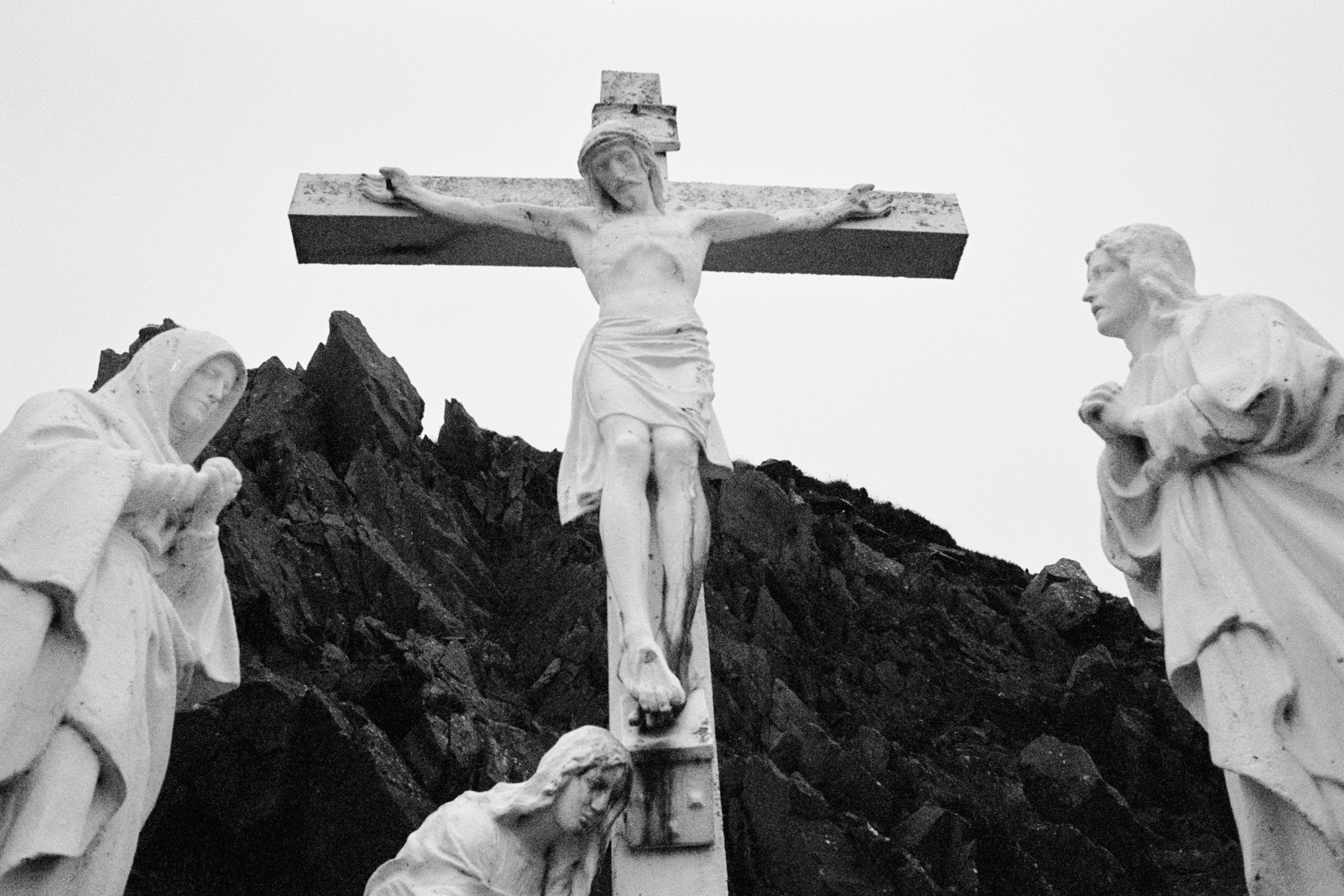
“When Jesus saw his mother and the disciple whom he loved standing nearby, he said to his mother, “Woman, behold, your son!” John 19:26
When I was diagnosed with cancer in 2011, the thing that crushed me most was having to tell my children. Knowing they would grieve with me was almost more than I could bear. I wanted to spare them the pain I knew they would suffer. But I was helpless to prevent it.
I suspect it was the same for Jesus, as he suffered the agony of the cross, watching those he loved in anguish below him. Especially his mother.
But he did what he could. He appointed one he knew he could trust to protect and care for her. No doubt he was thinking not just of his mother, but of his friend, John, as well. he knew this “disciple whom he loved” would be blessed in the caring for his mother.
In a way, Jesus’ words might be surprising. Perhaps we would expect him to say something like, “Put your trust in God and you’ll be fine.” Or “Why are you weeping? Where is your faith?”
But Jesus is compassionate. What a beautiful testimony to the character of our Saviour, that even in his agony, he was other-centred.
And he was practical. There’s an old Irish saying – ‘Trust in God but don’t dance in a small boat.’ Jesus knew the world in which he was leaving his mother, a world that was not often kind to women not protected and cared for by a husband or son. So he did what he could to ensure her well-being.
It brings to mind the words written by James, the most practical of the apostles – “Suppose a brother or sister is without clothes and daily food. If one of you says to him, “Go, I wish you well; keep warm and well fed,” but does nothing about his physical needs, what good is it?” (James 2:15,16).
Jesus is, as always, the example for us to follow, even in this. We too are to give practical aid where and when we can, with compassion and love, as Christ did, no matter our own circumstances. We too are to be other-centred, for when we do, we exhibit the true nature of Jesus and when that is revealed the world stands in awe. God is glorified.
I saw a beautiful example of this some time ago, at a Christian writers’ conference. I’d been suffering with what is called, ‘frozen shoulder,’ an extremely painful condition, but I had agreed to teach at the conference and felt I could not back out of that commitment. A woman I barely knew approached me just before my workshop began. “You’re in pain, aren’t you?” I was surprised, since I hadn’t told anyone about my condition. I asked her how she knew. She smiled. “I’m quite familiar with pain. I can tell by the way you’re moving. Just wanted to let you know I’m praying for you.” Then she walked away. It wasn’t until later that I learned that woman had a medical condition that gave her pain so severe she was required to wear a morphine patch to manage it.
That left me in awe, that someone, in such agony herself, would recognize my pain and petition the Lord on my behalf. She exhibited the compassion of Christ. God was glorified through her, and I’ve never forgotten it.
Have you ever been on a pilgrimage? Dictionary.com defines it as “a journey, especially a long one, made to some sacred place as an act of religious devotion.”
The closest I’ve come to going on a pilgrimage was the trip my husband and I took to Israel some years ago. It was a time of soaking up the word of God while being in the very places where the events of the Bible happened. It was a stirring time during which I experienced several moments of ‘epiphany’ and insight.
I remember one day in particular. I was alone, having had to stay behind with an elderly woman in our group who had taken a bad fall. While she rested in her room, I took a walk along the shore of the Sea of Galilee and stopped for a while to read my Bible. I landed on the calling of James and John in Matthew 4. When I finished and looked up, the sun was pouring through the clouds, striking the lake with a glorious stream of light and I was struck by the sudden realization that the very words I’d been reading had occurred in that place. And the words took on a deeper meaning, a more clear reality.
Going on a pilgrimage is a very old concept, one that began centuries ago. Some trace it back as far as Abraham, who was charged by God to leave his home and travel to a far country. It is believed Christian pilgrimages to the Holy Land began as early as the 4th century A.D.
True pilgrimage is not just about travelling to a far-away place. I like what Brian Morykon, Director of Communications at the Renovaré Institute, said about it. “It’s a journey undertaken with a humble heart and with an openness to be transformed. The pilgrim isn’t trying to get somewhere as fast as possible. She wants to become someone along the way. She’s willing to linger, to reflect, to slow down.”
That is exactly what I hoped for those who would read Abundant Rain, my collection of devotionals for writers of faith. I chose Deuteronomy 32:2 as the theme of the book: “Let my teaching fall like rain and my words descend like dew, like showers on new grass, like abundant rain on tender plants.” It has become my prayer for all my work, and I hoped it would be so for readers of Abundant Rain, that their writing would flow out to their readers with refreshment and enlightenment that would cause many epiphanies.
Although a pilgrimage is and should be a deeply individual thing, it is usually undertaken with others, and for good reason. The Christian walk is not a solitary affair. It is meant to occur in community.
After a time of prayer one day, I began to ponder the idea that writing is not done in isolation either, as many might suggest. Writing is a communal effort toward wholeness, both for the writer and all those who assist her, and for the reader as she takes in the words and then puts hands and feet to them in the world around her. So I launched the first Abundant Rain Pilgrimage, that I might share in a pilgrimage of words that bring epiphanies, with others.
That first group was small but mighty, committed to the process and the goal of “becoming someone along the way,” someone refreshed and rejuvenated by drawing closer to Christ.
I’m excited to launch a second pilgrimage in the days ahead, using Volume 2 of Abundant Rain as the catalyst.
As often happens, God has encouraged me along the way. I opened my email the other day to find a message from Malcolm Guite who has written a wonderful book called Word in the Wilderness, which “introduces poems about pilgrimage itself and our life as pilgrimage.”
I leave you with a few words from the poems Malcolm chose –
“At length I go unto the gladsome hill, Where lay my hope, Where lay my heart;”
(The Pilgrimage by George Herbert)
“And thus I’ll take my pilgrimage … My soul will be a-dry before; But after, it will thirst no more.”
(The Passionate Man’s Pilgrimage by Walter Raleigh)
And some words from Malcolm’s poem, First Steps, Brancaster:
“This is the day to leave the dark behind you Take the adventure, step beyond the hearth Shake off at last the shackles that confined you, and find the courage for the forward path.”
And finally, scripture:
“Blessed are those whose strength is in you, whose hearts are set on pilgrimage.”
A while ago our neighbourhood was turned into a beautiful winter wonderland. The temperature had dropped suddenly and for a while we were shrouded in thick fog. When that cleared, the sun came out and everything sparkled as though it had been painted with a fairy’s brush. The thick frost was dazzling. As I walked Livy that day I remember thinking,
What could be more beautiful?
I love where we live. It’s a quiet neighbourhood full of large trees, crisscrossed with walking paths dotted with boxes of doggie bags at strategic places. On a calm night we can hear the gurgling of the river behind us and the lights from the small town aren’t enough to block out the stars. Deer often wander up from the nearby woods and now and then a moose will jog down the street. I often fall asleep to the sound of coyotes yipping at the moon. Yes, I love it here.
But it’s not where my heart belongs.
My heart belongs in a faraway place that I’ve never seen, a place that, unlike our current home, can never be corrupted or destroyed. Matthew 6:19 & 20 says – “do not lay up for yourselves treasured on earth, where moth and rust destroy and where thieves break in and steal, but lay up for yourselves treasures in heaven, where neither moth nor rust destroys and where thieves do not break in and steal.” (ESV)
I thank the Lord every day for giving us such a beautiful place to live, but my true home is where my Saviour is, where my Heavenly Father lives. Remembering that truth keeps me from grasping for the eathly things that will fade away, rather than focusing on those things which are eternal.









 marcialeelaycock.com